
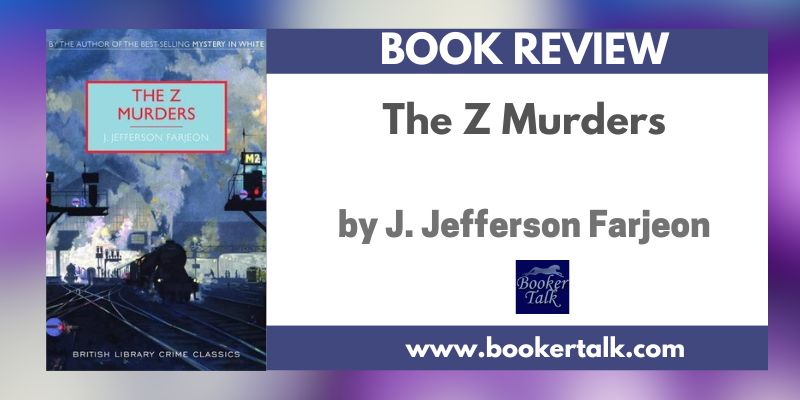

The British Library has done a first rate job of giving a new lease of life to neglected British detective novels with its Classics Crime series. It’s fair to say however there are significant variations in quality with The Z Murders by J Jefferson Farjeon not one I would rate highly.
Published in 1932 it’s a fast paced story of a serial killer, a plot device that was highly popular during the Golden Age of Crime (the period between the two world wars).
It starts well enough. Richard Temperley a passenger on an early morning train into London. He heads to a nearby hotel to waste a few hours sleeping in one of their armchairs before continuing his journey to Richmond. Within minutes he finds the body of fellow train passenger in another armchair and glimpses an attractive young woman leaving the room.
Temperley decides this mysterious woman is a damsel in distress who needs his help. He determines to track her down before the police can get to her, a decision that puts himself in danger.
The bulk of the novel is made up of Temperley criss crossing the countryside by car and train in pursuit of the mystery woman Miss Wynne, with a Detective Inspector hot on his trail.
It’s all highly melodramatic with a 150-mile cross-country car chase at night, an armless villain and exclamatory dialogue.
“You’re a devil if ever there was one,” blazed the countryman.
“And you’re a fool if you there ever was one, ” answered the man without arms. “Think I can’t see an expression when it’s reflected in glass? And read it? You should keep your face better — as I do”
The man without arms presented his expressionless face to the countryman. The countryman saw it through a red haze. In a sudden frenzy of combined anger and fear, he hurled himself upon his tormentor. The next moment, astonishment replaced the anger and the fear.
I know that people in books like The Z Murders often behave like no-one ever does in real life but this book really stretches credulity to its limit. Temperley has key information that could easily and quickly solve the mystery but does he do that? Of course not — he keeps schtumm, thereby causing more loss of life.
As if he recognised that the plot was rather complicated, Farjeon wraps it up with a long info dump and a happy ever after scene. Groan.
The most interesting part of the whole novel was that it revealed people could turn up a hotel in the 1930s, snooze in the lounge and get a hot bath without paying a penny. Can you imagine trying to do that today???






We’re all friends here. Come and join the conversation