

You don’t have to look for long to find a screen adaptation of John Buchan’s adventure novel The Thirty Nine Steps on a terrestrial or streaming channel. It seems to be one of those films that schedulers resort to when they need to fill an afternoon gap in their schedules.
They have multiple versions from which to select.Wikipedia lists three big screen adaptations, starting with Alfred Hitchcock’s 1935 black and white version. Kenneth More played the starring role of Richard Hannay in the first colour version in 1959, then came a 1978 adaptation with Robert Powell as Hannay. This is in addition to multiple radio adaptations, a stage production and even a video game.
While they’re all based on the same concept — a resourceful hero who stumbles upon a network of spies intent on plunging Europe into war — they all play fast and loose with Buchan’s narrative.
In the novella, Richard Hannay is an engineer who has recently returned to London from Rhodesia. Through a chance encounter with an American journalist called Scudder, he learns about a German spy ring that plans to assassinate the Greek Premier to destabilize Europe and cripple British naval security.
Soon after, Scudder is murdered. Hannay fears for his own safety if the spies discover his identity. He could also fall under suspicion as a killer. So he goes on the run, escaping to his native Scotland.
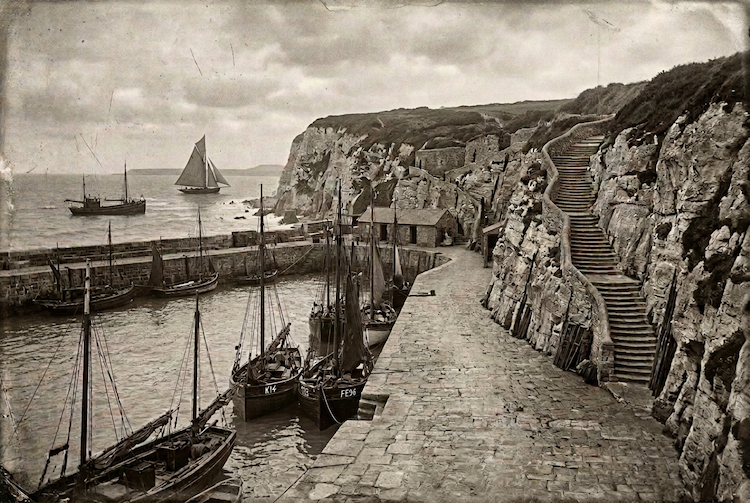
Hiding out on the moors he tries to decipher the clues left behind by Scudder in his notebook. The main challenge is to decode the meaning of “the thirty-nine steps”, the phrase Scudder used to describe the exact location from where the spies planned to escape England.
What did Scudder mean by steps? I thought of dock steps, but if he had meant that I didn’t think he would have mentioned the number. It must be some place where there were several marked staircases, and one marked out from the others by having thirty-nine steps.
It’s a race against time with police and his potential assassins hot on his heels.
If you enjoy a good old fashioned adventure tale, The Thirty Nine Steps, is just the ticket. Plenty of drama and action as Hannay’s increasingly desperate efforts to prevent the assassination leads him through a series of risky situations and narrow escapes. The narrative escalates to a final confrontation minutes away from the time planned for the conspirators’ departure.
It’s all thrilling stuff though you do need to ignore some wild stretches of imagination. Buchan’s plot depends hugely on Hannay’s ability to effect a disguise, a talent he proves to have in abundance. Assuming the disguise of a milkman is easy — it just takes a white coat, and a few empty milk bottles. Much harder to transform yourself into a lowly road repairer with a very strong Scottish accent and get away with it.
What you won’t find in the novel is Hannay’s escape from a train and the parapet of the Forth Bridge. That was pure Hitchcock. Nor does Hannay hang from the hands of the Big Ben clock in Westminster as in the 1978 film, And there’s certainly none of the romantic interest that appears in all three big screen adaptations.
It would be easy to dismiss Buchan’s narrative as nothing more than an action novel with a have-a-go hero who has a knack of wriggling out of a tricky situation. Buchan himself described The Thirty Nine Steps as a “shocker” — by which he meant a story containing unlikely events which the reader is only just able to believe that they really happened
But there’s a bit more to it than that. Buchan played into the spirit of the age with Richard Hannay embodying the principles of duty and integrity beloved of his early readers. At the time the novel was published (1915) Britain was in the throes of war and the magnitude of human loss had yet to hit home. Here was a hero that was doing exactly the same as all those young men who volunteered for service — doing “the right thing” by putting their love of country above their own safety.
I read this for Novellas in November hosted by Cathy of 746 Books and Rebecca of Bookish Beck to celebrate short novels of no more than 200 pages. By happy coincidence I can also claim this for Reading Scotland Month hosted by Joanne of PortobelloBooks.



We’re all friends here. Come and join the conversation