

Beauty and ugliness go hand in hand in Thousand Cranes by the Japanese Nobel Laureate Yasunari Kawabata. It’s written in a wonderfully elegant and lyrical prose yet what it describes is the kind of love that tips into jealousy, resentment and obsession.
In this short tale we experience the tangled love life of Kikuji, a Tokyo office worker in his late twenties. As the novella begins he’s on his way to a tea ceremony being held in honour of his late father. The hostess Chikako — who was briefly his father’s mistress — intends to play the matchmaker by introducing Kikuji to Yukiko Inamura, a beautiful young woman with good family connections.
Kikujo is indeed very taken with this girl from the moment he sees her hurrying to the ceremony bearing a kerchief patterned with images of a thousand cranes. But the relationship doesn’t progress beyond the initial introduction. Instead, Kikuji is drawn into an affair with Mrs Ota— the very woman who supplanted Chikako as his father’s mistress And so begins a tangled web that brings happiness to no-one and great suffering to others.
Chikako already hates Mrs Ota as a rival in love. Now her animosity is deepened because the woman has thwarted her scheme s to arrange Kikuji’s marriage. Chikako also worries that Kikuji is becoming too friendly with Mrs Ota’s daughter Fumiko. A marriage between those two is definitely not in her plan, Chikako is a woman who loves to exert her power and influence and won’t tolerate being crossed.
So she takes to meddling even more in the lives of these young people. One day she turns up unannounced at Kikuji’s home with some spurious excuse that she needs to clean the tea house. She concocts some false story that Fumiko has got married and pushes the gentle innocent Yukiko Inamura into Kikuji’s path once more.
if we don’t get the message from the plot that Chikako has an ugly, malicious nature. there’s a strong clue in a detail about her physical appearance. Almost the first thing we learn about this woman is that she’s disfigured with black hairs sprouting from a purple-black birthmark on her breast. Such a mark, could have long -lasting consequences for any child she bore, Kikuji’s mother believes.
From the day it was born it would drink there, and from the day it began to see, it would see that ugly birthmark, and there the impression would be, through the child’s whole life.
Chikako is effectively branded a poisoner, a woman whose jealousy inflects the lives of innocent people who come within her orbit.
The nevus is one of several symbols used in Thousand Cranes, the significance of which I suspect can only fully be understood if you are very familiar with Japanese beliefs and customs.
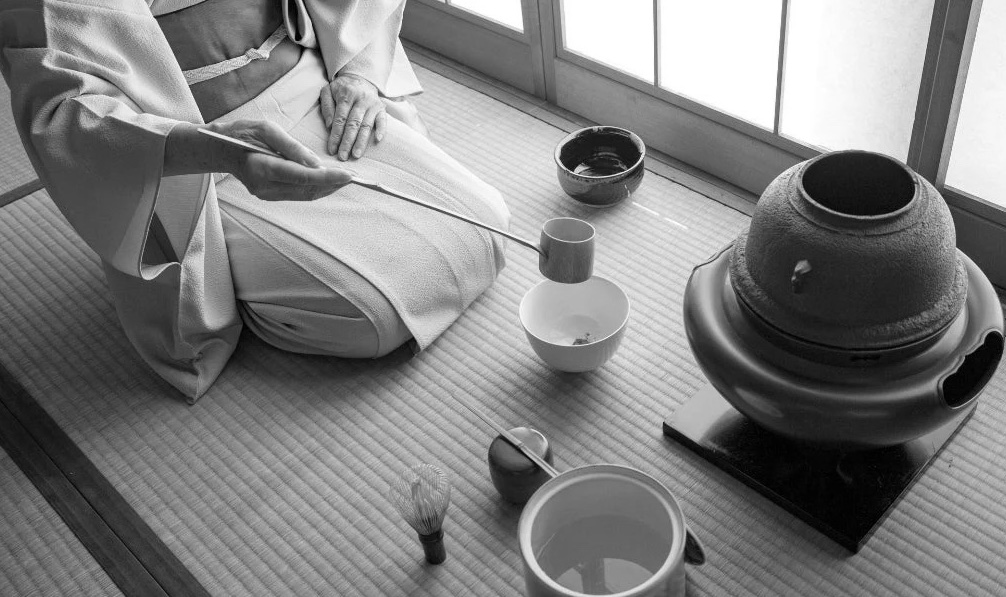
The tea ceremony plays a key role in the tale. It’s a way of bringing all the major characters together and is a means by which Chikako — a teacher of the ceremony — can try to re-assert her influence over Kikuji.
The utensils used in the ceremony represent the beauty that acts as a counter to Chikako’s ugliness but also have special symbolic meaning for the characters. In one scene Kikuji and Fumiko enjoy a private moment at her home, drinking tea from Raku bowls made by Ryōnyū. Of course I absolutely had to know more about those bowls — a quick bit of research told me that Raku is a type of hand-crafted ceramic bowl highly esteemed in the tea ceremony. Ryōnyū was a master craftsman in the sixteenth century so Fumiko’s bowls are particularly precious.
They were made by passed down to Fumiko by her mother. Kikuji ends up reflecting how both of them have taken on the fate of their parents through the form of the bowls. They both feel a deep sense of guilt for the actions of their parents in the past and somehow believe they carry that guilt with them. Their discussion about the provenance and meaning of these bowls also reveals feelings for each other that are deep, yet unspoken.
Thousand Cranes is a beautifully crafted, haunting novel. It has a lot of depth that I kept feeling lay just beyond my grasp. That didn’t spoil my enjoyment but I know I would have enjoyed it even more if I’d understood all those layers of meaning .




We’re all friends here. Come and join the conversation