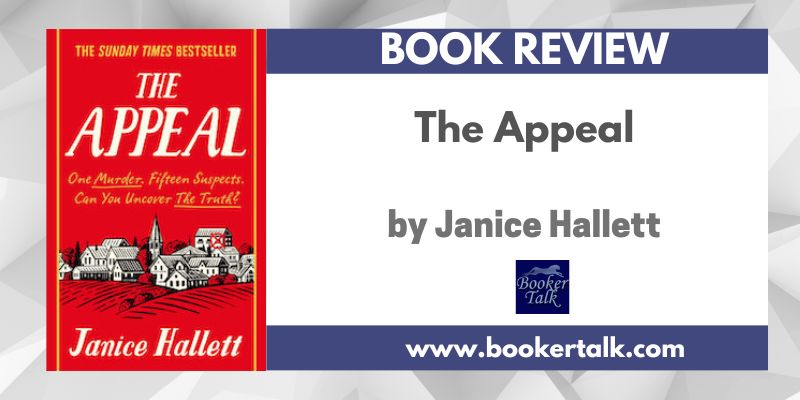
I seldom read bestsellers, particularly those in the crime fiction genre, but I succumbed to The Appeal for two reasons.

1, The plot involves members of an amateur dramatic society in a small town. Having been up close and personal with some of these individuals in recent years I know to expect plenty of tension, in-fighting, drama and banter.

2. It had novelty value — readers of this book are challenged to take an active part in solving a mystery.

The premise of The Appeal is that a British barrister is convinced the wrong person has been imprisoned for killing a member of the Fairway Players amateur dramatic society. He directs two juniors in his chambers to re-examine all the evidence and present him with an argument that will convince the appeal court.

The narrative is constructed from evidence in the form of email exchanges, text messages, voicemails and newspaper clippings, plus the summaries and commentaries from the two junior barristers.

Structuring a novel in this fashion is a risky strategy.

Emails and text messages are so often dull and can be doubly tedious if you don’t understand their context or the individuals involved in the communication. The messages have to be detailed enough to convey the story and capture the essence of the various personalities involved but if they’re loaded with too much detail, then they just sound like an info dump.

The first few pages were confusing. I felt bombarded with names of people, many of whom were related by blood or marriage and had to keep referring back to the extensive character list at the front of the book. Fortunately, this issue got resolved as the book progressed and more distinctive voices came to light.

In addition to individual names, there’s a lot of other detail to keep track of — dates, timings, past histories — so you have to have your wits about you as you read this novel. You also have to pay close attention to the gaps in information where the writers of those emails/text messages leave out certain detail (by accident or deliberately we don’t know).

Hallett tried to get around this with periodic breaks in the message chatter where the lawyers recap everything they’ve learned and identify questions yet to be answered. These summaries did help to bring everything together, reminding me also what I’d learned and highlighting significant info that I’d missed. But they just didn’t feel like real exchanges between two colleagues.

For all that, The Appeal a reasonably entertaining read that will satisfy people who enjoy following a trail of hints about the killer’s identity and the motive for their crime. It perfectly captures the squabbles and minor irritations you find in any organisation — right down to one character’s high-handed attitude over meeting minutes — while tackling some bigger issues about the potential for fund-raising efforts to become embroiled in fraud.

14 responses to “The Appeal by Janice Hallett — a murderer’s email trail”

  1. Ah, this one sounds fun! But I find that initial confusion is getting more and more common with mysteries/thrillers. It’s like authors feel so compelled to THROW THE READER INTO THE ACTION that they sacrifice us being able to actually work out who’s who in the zoo lol

  2. I was recently thinking about Crime as a genre morphing into Literature, and this seems to be the opposite, just an assemblage of clues for people who solve puzzles.

    1. Well there are authors who write at the more literary end of crime (I’m thinking of John Banville for example) but this one is aimed at the more popular end I think. One of the books that was getting heavily promoted around Christmas here was a quiz book based on crime fiction and of course we have the Richard Osman phenomena….

  3. This format reminds me of Jackdaw history folders that used to be available for schools – reproductions of documents, handbills, prints, registers etc that would relate to a particular period or historical issue which students would have to peruse to learn the background and answer pertinent questions. In essence, the skills required of a good researcher, whether historian, scientist or, as here, lawyer.

  4. The amateur dramatic setting was the best part of The Appeal for me, the characters and their relationships were amusing and all too recognizable. The email/text format sometimes worked well, but sometimes became strained and unbelievable. In the case of the WhatsApp exchanges between the lawyers it didn’t make sense that they would not simply have a phone call or in-person conversation.

    I’ve had even more mixed feelings about the rest of Hallett’s books, to the point where I’m not going to read another one if it involves a formatting gimmick. I’d be interested to see what she can do without that, but she seems to have gotten stuck with this strange niche genre.

    1. I suspect her publishers “guided” her, thinking that she had such a winning formula first time around that the success could be repeated. But there are diminishing returns. The Appeal filled a need at the time for some lighter reading material but I’m not likely to want to read anything else by her, especially if it just more of the same

  5. I really struggle with books that use emails, and text messages or similar, they just put me off. As you say it takes skill to make them a positive part of any narrative.

    1. Those What’s App messages that got released to the Covid inquiry show just how mind-numbingly boring such things can be

  6. I enjoyed this much more than I expected to, although I agree that it needs a lot of concentration. Her novella, The Christmas Appeal, is entertaining as well and features a lot of the same characters which made it easier to follow.

    1. I don’t think I’ll be in a hurry to read anything more by her Helen. I did enjoy The Appeal up to a point but I suspect that the formula of a text message/email message narrative would lose its novelty value quickly for me

  7. I quite enjoyed this when I read it 2 or 3 years ago, but not enough to be tempted by her subsequent books, which apparently use a similar device.

    1. That’s what I understand Margaret. There are only so many emails I can take!

  8. I’m intrigued by your involvement in amateur dramatics, Karen. Whatever it was I hope nothing nefarious occurred!

    1. Ha Ha! It was my husband who actually did the appearances – I was just there as moral support and an aide when it came to learning lines. Two of our friends run a theatre company also so I get plenty of insights into all the backstage antics!

We're all friends here. Come and join the conversation

This site uses Akismet to reduce spam. Learn how your comment data is processed.

Trending

Discover more from

Subscribe now to keep reading and get access to the full archive.

Continue reading