
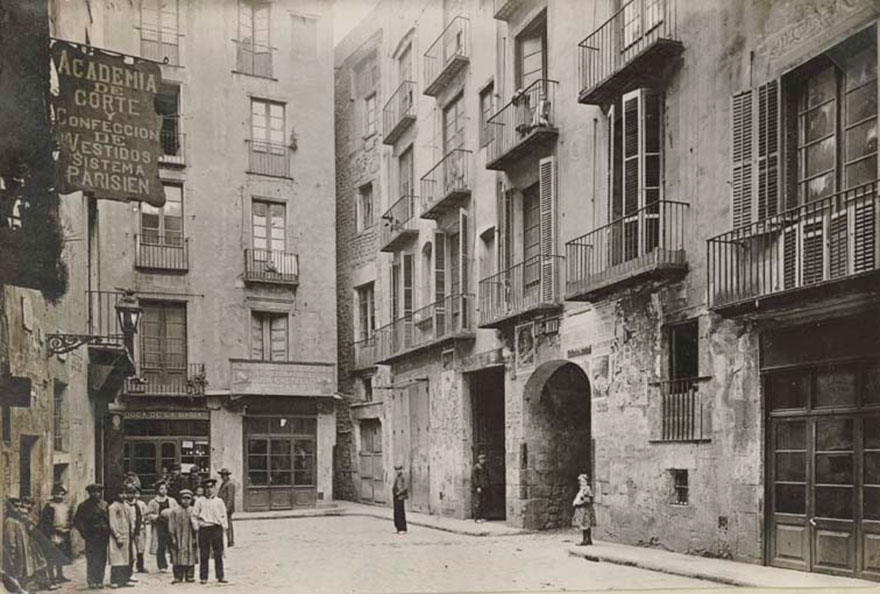

Carmen Laforet’s debut novel, Nada, is a grim tale of an orphaned young woman and the wretched, dysfunctional relations with whom she goes to live in Barcelona.
Eighteen-year-old Andrea arrives in the city to take up her place at university. She remembers fondly her last visit to her grandparents’ home on Calle de Aribau but what confronts her is nothing like the lavish apartment she recalls as a child. In its place she finds a dark, damp, rotten-smelling warren of rooms stuffed with furniture and ornaments that stand as reminders of former glory years.
Even the occupants seem dwarfed and shrunken. When Andrea encounters her grandmother on her first night she doesn’t immediately recognise “the black-white blotch of a decrepit little old woman in a nightgown.” The apartment’s bathroom reminds Andrea of a witches’ house.
The stained walls had traces of hook-shaped hands, of screams of despair. Everywhere the scaling walls opened their toothless mouths oozing dampness. Over the mirror, because it didn’t fit anywhere else, they’d hung a macabre still-life of pale bream and onions against a black background. Madness smiled from bent taps.
Everything and everyone in this house seems warped. Her uncle Román is a rogue who gets embroiled in the black market and her other uncle Juan is a frustrated artist who uses his wife as a punch bag because he can’t sell his paintings.
The women are not much better. Aunt Angustia is an uncompromising authoritarian figure whose religious zeal is at odds with her secret lover. Then there’s Juan’s wife Gloria who leaves her baby son at home while she goes out to play cards in the slums. The poor woman is however just trying to survive, using her winnings to buy food of which there is precious little in this household. Andrea herself exists on meagre rations; soup in a cheap restaurant and a loaf of bread washed doown with the water used to cook the family’s vegetables.
The only glimmer of hope for Andrea comes when she’s taken up by a fellow student. Ena — beautiful, charismatic and wealthy — gives the poor and shabbily dressed outsider a glimpse of another world. It proves to be a hollow and short-lived relationship however when poor Andrea discovers her so-called “friend” is just out to avenge a family wrong.
Nada is set in 1940, the first year after the end of the civil war and the first under the dictatorship of General Franco. It’s hard to find work, leaving many of the city’s inhabitants starving and huddled in doorways and alleyways. There are some old scores to be settled with police still on the hunt for the “reds” in their midst.
Overlying the theme of a country coming to grips with a new reality, is a coming-of-age tale, showing a orphan girl from the Canary Islands navigating her way through a complex maze of family dramas and relationships. By the end of the novel, Andrea finds a way to escape her family and Barcelona yet this doesn’t feel like a resolution to Madrid, but there’s a suggestion that this is not a complete resolution. She leaves the apartment on Calle de Aribau to begin a new life yet she all the things she had hoped for in life “joy, deep interests, love” have not materialised. Perhaps this is the significance of the book’s title which in Spanish means “nothing”. She has ‘ things’ — a new job, security and a comfortable place to live, but is still missing the joy of life. Or am I reading too much into this?
Nada is an extraordinarily powerful novel. Yes it’s dark and bleak but it’s also rivetting.






We’re all friends here. Come and join the conversation