
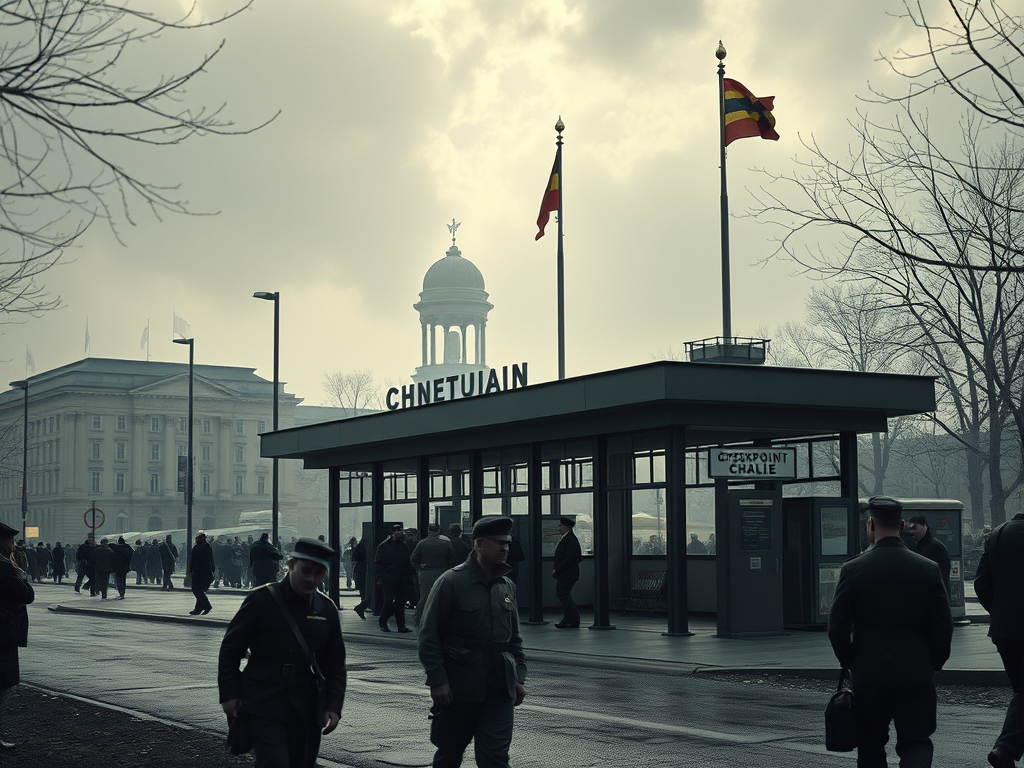

The Silence in Between was inspired by a true story of a mother separated from her baby when the border between West and East Berlin was closed in 1961.
In Josie Ferguson’s version, the separation of mother and child is used as a jumping off point for a novel about the legacy of war and particularly the sexual violence enacted as revenge upon the conquered.
It’s August 1961 when the novel begins. Lissette leaves her small son in hospital in East Berlin, returning to her husband and teenage daughter Elly in the western sector. When Lissette wakes the next morning it’s to discover the border sealed with barbed wire fences and makeshift barriers. Travel from East to West Berlin is now forbidden and anyone making at attempt to cross is likely to be shot.
Days of despair ensue when all attempts to connect the hospital prove futile. The trauma leaves Lisette mute and even more remote from her daughter. Elly decides the only way to regain her mother’s love is to risk death by travelling to west Berlin herself and retrieve her baby brother.
The Silence in Between uses two time frames. One strand begins with the construction of the Berlin Wall and follows Elly’s attempts to carry through her risky mission. The other follows her mother Lisette through World War 2 and its aftermath when East Berlin comes under Soviet control, revealing the reason for Lisette’s coldness towards her daughter.
Invariably one strand is stronger than the other. That set in the 1960s and beyond comes across as an adventure story of a “heroine” whose character remained on the surface. It suffers greatly from a lack of credibility. Elly has more than her fair share of luck and fortunate encounters in her journey to the west. A Russian soldier who becomes her ally; former family friends who take her into their home; a student group who digging a tunnel to the West. It all reads rather too easy.
The authenticity and depth of character missing from Elly’s story is more evident when attention turns to her mother. Lisette endures many disturbing and traumatic events over the decades, leaving her unable to hear or play music or to show affection towards her daughter. Her father goes off to war, then disappears. She’s pressured to view her neighbour’s obnoxious Nazi officer as a marriage prospect; she and her mother endure food shortages and then the Allied forces bombing raids. All these she survives, but it’s when the Russians arrive that the horror truly begins.
The significance of the book’s title plays out in the mutism that befalls Lisette consequently but it also connects to her tacit acceptance of the treatment meted out to the Jewish population of Berlin. She witnesses round ups and deportations but says and does nothing “Evil demanded little of me – it merely asked me to remain silent, to do nothing,” she reflects. It’s not until years later, when it’s evident that the Nazi regime is on its way out, does she feel able to give voice to her feelings. “.. we are guilty. We did nothing, and in doing nothing we gave our consent. … Their blood was on my hands.
While The Silence in Between is not without its faults, it was overall worth reading. It was evident that the book was grounded on extensive research into the period — there’s an extensive list of resources at the back of the book. Even Elly’s ability to judge a person’s character by the musical notes they emit (a skill I found hard to believe) is apparently borne out by scientific research into the different ways we think.






We’re all friends here. Come and join the conversation