
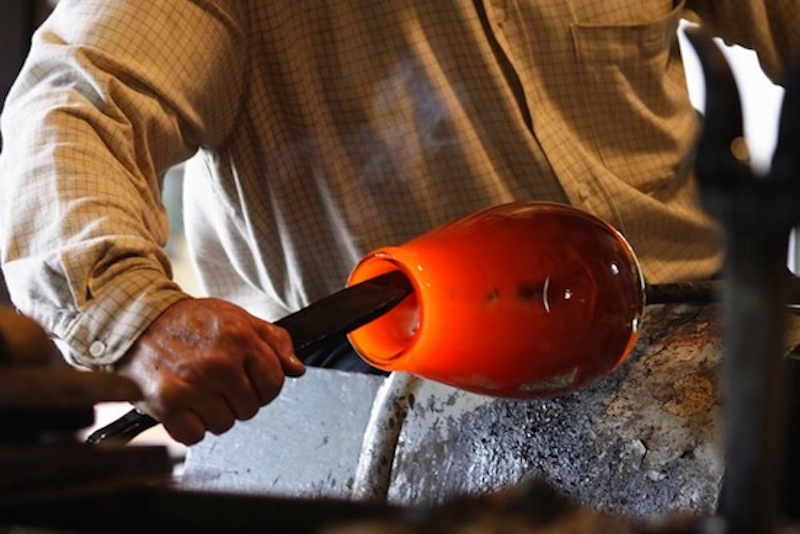

Tracy Chevalier entered new territory with her eleventh novel The Glassmaker. As in all her previous novels, it has a vividly explored historical setting and a strong female protagonist. What’s different is Chevalier’s use of a time-shifting mechanism to show one woman’s life and the history of Venice over the course of some five hundred years.
The Glassmaker begins in 1486 with a glassmaking family on Murano Island in the Venetian Lagoon
The Rosso business is threatened when the father dies in a gruesome accident. His son Marco takes over but he doesn’t have his father’s eye for detail or his skill. Glassmaking is very much a man’s work but to help make ends meet, his 17 year old sister Orsola learns to make glass beads.
Her brother is scathing; viewing her beads as little more than rabbit droppings, nowhere near as important as the drinking vessels he tries to produce.. But Orsola perseveres, becoming so skilled that even an empress wants a necklace created from her beads.
The novel follows Orsola as she fights for recognition in a society that believes only men can be glass makers. We see how the fortunes of her and her family are impacted by events outside their control — over a span of 500 years they suffer hardship during the plaque years and prosperity during the Age of the Enlightenment. Time jumps on several times through the book, through the unification of Italy and two world wars before coming up to date with the Covid pandemic.
Time passes in the novel “like skipping stones” yet the main characters remain the same, their ages changing only slightly from one chapter to the next. Each chapter begins by setting the scene:
The stone skims across the water, landing in 1915, several months into the Great War. Orsola Rosso is turning back and forth in the flame a red bead in the shape of a drop of blood. She looks up, and seventy- one years have passed. She and those who matter to her are four years older. Orsola is fourty four. So much change in so little time. Austrians, kicked out of Venice. Italy unified. Electricity harnassed. Factory production line perfected. Cars invented. Motors ubiquitous.
This time hopping device — “time alla Veneziana”, as Chevalier calls it — gives breadth to the novel, enabling her to capture the ebbs and flows in the history of Murano. At the same time it allows for a narrow focus, because we follow the same set of characters from one century to another. The idea was possibly to show how the essential nature of a city and of an individual, endures despite all the changes in their world. By the end for instance we see Orsola a fully “modern” woman with mobile phone in hand, yet her determination and loyalty remains undimmed.
Nature was continuing its march, indifferent to human suffering. Whatever was happening to people, the world would always be here, the tides flowing in and out, the flowers blooming, the birds singing. It was not an original idea, she knew, but she found it comforting. In a way, humans too continued their march, eating and sleeping and making and loving, whatever the circumstances.
It’s an ambitious concept but I wasn’t entirely convinced of its effectiveness. This is an immersive story rich with the colour, sounds and scenes of Murano and its neighbour across the lagoon. We learn a lot about the art of glassmaking and what makes Murano glass so highly prized. But the jumps from one century to another took me out of that world and it took a while to adjust to the new environment.
I also got the sense that Chevalier was trying to cover too many “points” — cramming in everything from war and competition from Prague to rising sea levels, floods and mass tourism.
I’d have been more than happy with a narrative set entirely in the fifteenth and sixteenth centuries. That would have given allowed me to spend more time in the workshops of the Rosso family. Just as she did in other novels Chevalier has opened my eyes to the world of artisans and artists— painting in Girl With a Pearl Earring, tapestry weaving in The Lion and the Unicorn and church embroidery in A Single Thread). Now all I have to do is persuade a certain someone in my family to take me to Murano so I can indulge my new found interest in glassmaking.



We're all friends here. Come and join the conversation