
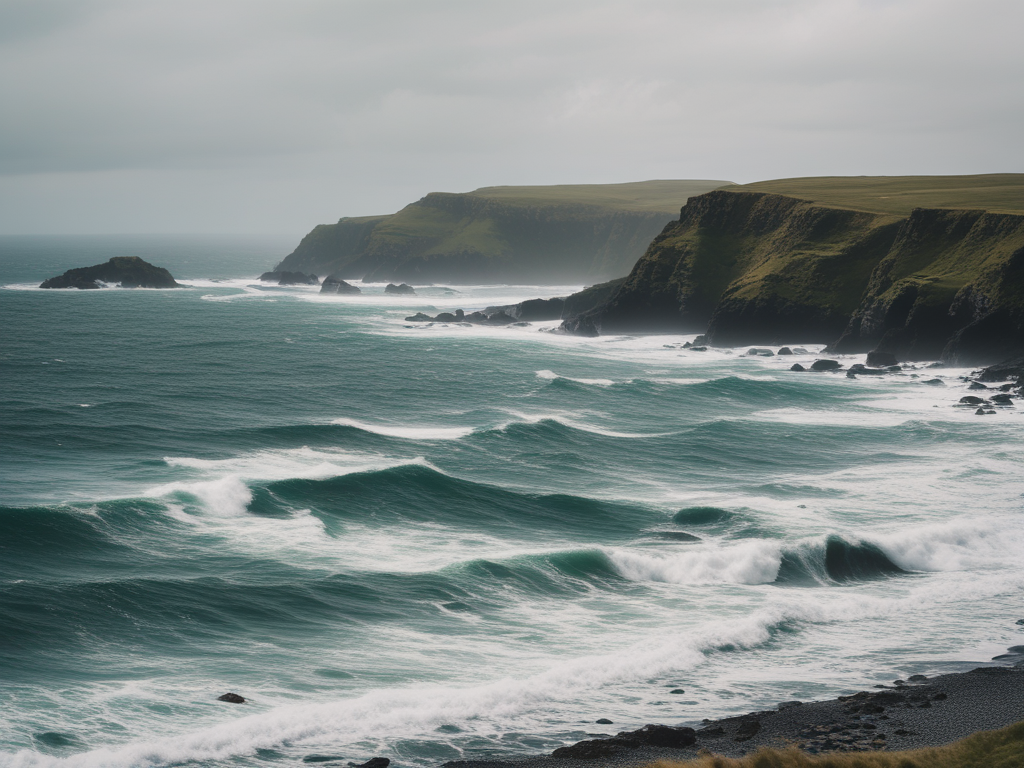

The Fall of Light, Niall Williams’s third novel, is a panoramic tale of the struggles and hardships endured by Ireland’s rural poor in the nineteenth century. it’s a vast subject that Williams makes more digestible by narrowing the focus to one family — the Foleys —whose misfortunes echo those of millions of their countrymen.
The novel is set in the 1840s, a period which saw the population of southern Ireland decimated by repeated failures of the potato harvest. Williams doesn’t shy away from the horror but treats the famine as a background element rather than a driving force in his narrative.
The misfortunes that beset the Foley family have in fact nothing to do with the famine. They stem from the pride and discontent of one man.
Francis Foley, the patriarch of the Foley family, resents the hours he spends toiling on land owned by another man. He dreams of his own piece of land and a good home for his wife and sons. His restless nature sees him move from place to place in pursuit of that dream.
His wife decides she’s had enough of this nomadic life and walks out on him and their four sons: Tomas, twins Finbar and Finan and Tiege. In anger, Francis breaks into the home of his wealthy landlord, steal his telescope and set fire to the house. He flees with the boys to seek ”a place beyond magistrates and bailiffs and agents . . . a place to live in that was empty.”
The bulk of The Fall of Light traces the paths taken in life by each member of the Foley family after that flight from justice.
Two of them end up on the other side of the Atlantic. One son joins a caravan of gypsies on their odyssey through Europe, making a new life with a “mer girl” (a kind of mermaid apparently). Another becomes a fugitive from the law and ends up as a missionary in Africa. Francis himself finds peace on an island in the River Shannon, from where can make ” a clear sense of the world” by examining the stars.
Adventures and mishaps abound as the Foleys scatter far and wide across the world. Their paths sometimes cross and intersect, but even when physically apart, each man holds fast to the spirit of kinship and family. ”In the dark then Teige Foley sailed free of that place in his mind and found and reassembled his family. . . . To himself he told of them as if they were stars.”
Family Legends
The trials and exploits of the Foleys become the stuff of legend; stories told and retold by each generation of Foleys, What we get in the novel is one version of the family history, as recounted by a third generation Foley. Like all family stories this may not be the definitive account.
This is a story that has been passed on. … It has been told and retold for over a hundred and fifty years. It is not a history. … It is a story of a family that is mine. Although its figures have become outlandish in the telling and dates and times and places been lost to the inexactitude of memory and invention, I recognise them yet.
Like all family histories, this one is a rambling account with many disparate strands and diversions. The narrative constantly shifts its focus from one member of the Foley clan to another, so it reads more like a series of episodes than a flowing continuous narrative. Of necessity there’s a fair degree of backtracking and filling in of gaps in information as the narrative seques from one Foley to another.. Occasionally the connections felt very clunky. We get for example: “And by that time, in the caravan of gypsies, far away, Finbar Foley was travelling south with a mer-girl called Cait.“
and
“Francis Foley and Teige and the young girls Deirdre and Maeve were similarly journeying.”
The Fall of Light sometimes labours under the weight of its own content — Williams does seem to want to pack a lot into his narrative — and it feels a slow read as a consequence. Stick with it though and you encounter some beautiful evocations of the landscape of south west Ireland.
.
.

The Fall of Rain was one of the books in my — now abandoned — #20booksofsummer list for 2024.




We’re all friends here. Come and join the conversation