
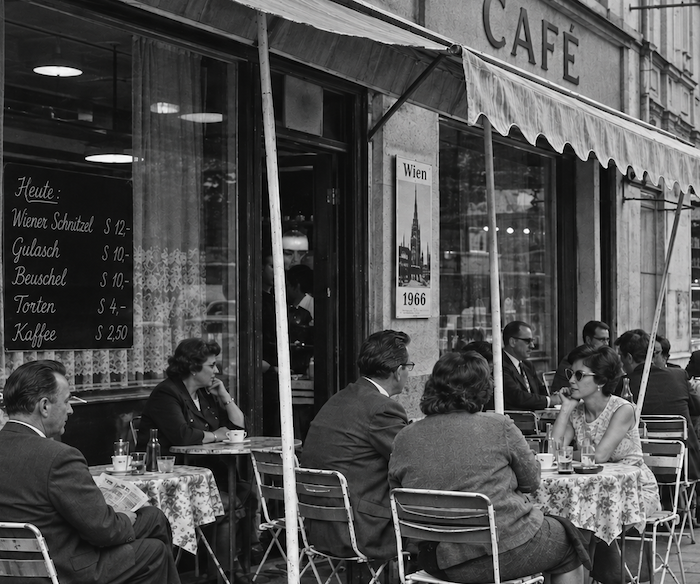

The Café with No Name is a wonderfully modest novel, very much in the vein of Robert Seethaler’s earlier book A Whole Life.
Set in Vienna in 1966, the novel follows Robert Simon, a 31-year-old who decides to leave his jack-of-all- trades job at the market and take over a dingy café at the Karmelitermarkt.
Robert has never worked in a cafe let alone run one. He has no grand business plan and, rather appropriately, never even gives the café a name. What he does have is a vague feeling that he needs to do something with his life. The café becomes that something.
It’s not a promising business prospect — this isn’t the kind of Viennese café where customers linger over sacher torte and decadent creamy hot chocolate. The menu in Robert’s establishment is limited: bread, dripping, and gherkins. Yet it’s convenient for the workers and stallholders from the market and lonely souls simply looking for a place to sit for a while.
Before long, it becomes much more than a place to buy a coffee, a glass of beer or sample the punch in winter. The café becomes a sort of unofficial community hub for the people around the market. Everyone who walks through that door brings their whole messy life with them. They find a patient listener in Robert.
Mila, a former factory worker, joins Robert behind the counter, while a colourful collection of regulars gradually becomes part of the café’s world. Among the clientele are: a fading wrestler who has a soft spot for Mila and a local cheese-seller who falls for a painter.
Though there are accidents, deaths, romantic entanglements and moments of genuine drama, they arrive almost casually. Life happens, rather than being carefully arranged into a story.
Opening the café had fulfilled his dream but now he was becoming aware of the sober fact that every dream disappears the moment it becomes true, In place of his vague but at least broad prospects , he now had petty tasks and annoyances … but every time he tried to imagined a different life , he came to the conclusion that it wasn’t that bad after all,
There are characters whose stories seem to be heading somewhere, only for Seethaler to leave them behind and move on to somebody else. Some threads are picked up much later; others simply disappear. The Café with No Name is much more interested in the texture of life than in tying everything neatly together.
Meanwhile Vienna itself is changing — the old postwar rubble-and-rationing city giving way, slowly, unevenly, to something newer and less certain. You feel that shift mostly at the edges: a mention of construction on the new subway line, references to a booming, more American-flavored future everyone’s chasing. The café, stubbornly old-world, becomes a kind of last outpost of something that’s already disappearing while it’s still open.
The Café with No Name is an evocative novel rooted in real life and events that shaped a city. The occasional melancholic note is well balanced by flashes of humour and genuine warmth. So nothing dramatic and yet, somehow, Seethaler turns all of this into something quietly moving.




We’re all friends here. Come and join the conversation