
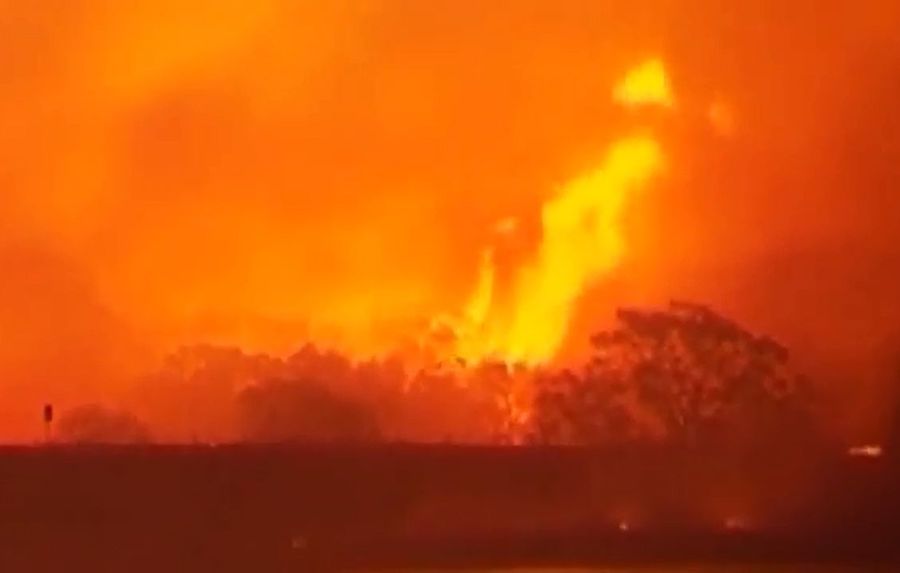

What kind of a person would deliberately set fire to a tinder-dry plantation, causing ten deaths and the destruction of houses and thousands of acres of farmland?
In The Arsonist, Chloe’Hooper sets out to answer that question through an account of the investigation into a fire in the Australian state of Victoria on 7 February 2009.
That day fire crews and residents in the Latrobe Valley — a farming and coal mining area about 160k east of Melbourne — were on high alert. Several days of high temperatures — climbing to the mid 40sC — and low rainfall had turned forests, plantation and farm lands into tinder boxes.
That afternoon a fire started near a eucalyptus plantation, rapidly gaining momentum in winds gusting to 100 kilometres per hour. By the following afternoon it had reached settlements seven kilometres away and showed little sign of running out of power.
Investigators quickly concluded that this was no accidental inferno. Just as quickly, they honed in on a suspect;: Brendan Sokaluk, ,a 42-year resident from the nearby town of Churchill. He’d been in the area of the fire that day and his car had been abandoned just a few metres from where the blaze started. His behaviour also seemed odd.
The Arsonist begins from the perspective of the investigators. It later switches to the points of view of the lawyers defending Sokaluk. The intention is clearly to give a balanced perspective with a narrative written predominantly from a detached third-person viewpoint.
Based on interviews with survivors, Hooper reveals the horror of that day and its lasting consequences Individuals lost friends and relatives, they lost their homes and their livestock. Their community, already blighted by a shift away from coal and job losses, was left deeply traumatised
Some people had stayed in their homes on the day of the fire, thinking it was safer because they had no idea where the flames were or in which direction they were heading. Others took a risk and tried to make it to relatives nearby only to find themselves running straight into the fire.
… a beast has found them: at the end of the driveway, a spot fire ignites in the next paddock. Then , all at once, burning debris — not just airborn embers but flaming branches _ falls everywhere, along with fat drops of black rain.
Set against these personal accounts, Hooper gives readers multiple reasons to feel sympathetic towards Sokaluk. He was, we learn, on the autism spectrum; a diagnosis reached only after his barrister pushed for an assessment. Bullied and harassed all his life, he’d been unable to form any lasting friendships or relationships.
In the final section of the book, as the case approaches the trial, Hooper begins to ask searching questions.
Was Sokaluk too easy a culprit? Was he someone who conveniently fitted the bill. Why wasn’t more consideration given in the trial to his autism? Was the evidence largely circumstantial rather than robust?
Hooper isn’t looking to come down on one side or another in this book because she never categorically makes her stance clear. But by the end I felt she believed Sokaluk was guilty but deserved more from the justice system.
The Arsonist is a fascinating book. Hooper places her narrative against a background of climate change, and the economic decline of a community dependent on a few big employers. We learn a lot about bushfires —how they start (deliberately or accidentally), how they spread and how they’re investigated. Hooper leaves us with a sobering thought: that we can expect conflagrations on the scale seen in Australia in 2009 to happen in the future and more frequently.
If I wanted proof of that it came within days of finishing the book when N=news channels began reporting on huge wildfires in Southern Europe; the worst wildfires ever recorded in the region. So far they have claimed the lives of 50 people.





We’re all friends here. Come and join the conversation