
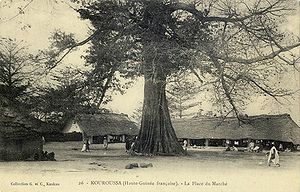

The second leg of my Adventures in African Literature took me north to the former French colony of French Guinea (now the independent nation of Guinea).
The Dark Child by Camara Laye is a memoir of his childhood years in the village of Koroussa and schooldays in the capital city of Conakry, documenting the beliefs and rituals that underpin the life of his family and fellow members of the Malinke tribe.
The Dark Child begins when Camara Laye is first made aware that his father has a protector in the form of a shiny black snake — “the spirit of our race” — who speaks to him in dreams and advises him about future events.
We learn that Laye’s father is a man of significance. He’s an expert metalworker and goldsmith, much sought after by people who want to convert fragments of gold into a treasured piece of jewellery for a special occasion. Laye watches in awe the great ceremony attendant on these commissions, with rituals and incantations so powerful they could be performed only by his father.
What were those words my father’s lips were forming… I was never told. But what else could they have been if not magical incantations? Were they not the spirits of fire and gold, of fire and air, of gold married with fire … was it not their help and their friendship he was calling upon in this marriage of elemental things?
Rituals form the backbone of this book, marking Laye’s passage from childhood, through initiation and circumcision to manhood. By the time the book ends, Laye is about to embark on a new phase of his life , one which will take him far away from his parents and his country.
There’s inevitably a tone of nostalgia and idealisation s Laye recounts his experiences, But his recollections of the simplicity of childhood joys and the beauty of his homeland aren’t overly sentimentalised or romanticised.
Early on for example, he describes the joyfulness of the weeks he spends with his grandmother in the farming community of Tindican, being fussed over and playing in the fields with the village boys. What impresses him most however is the way the community comes together at harvest time, the reapers working in harmony to the beat of the tom toms.
They were bound to one another, united by the same soul: each and every one was tasting the delight, savouring the common pleasure of accomplishing a common task.
Mixed with this pleasure is an element of sadness. As much as Laye relishes being part of this enterprise and admires the dignity of the work done by his father and his uncle (a farmer), he knows that this is not the future that awaits him. His success in school is moving him further and further away from both forge and farm, a fact he faces with a mix of pain and excitement.
He wants to stay in his village and to honour the Malinke tradition where a son is expected to follow his father’s occupation. But Laye recognises that his family has made sacrifices so he can achieve something more in life than to work on the land or with his hands. His parents, too are caught in this conflict: they want him to succeed but know that this success will take him away from them. His mother is especially enraged when her son announces he’s been offered a scholarship to continue his engineering studies in Paris but his father supports Laye, having anticipated for years that this would be the likely outcome of the boy’s thirst for knowledge.
He does extract two promises from his son however; that Laye will seize all the opportunities awaiting him in France and, secondly will one day return to his country. “Soon we’ll be needing men here like you,” he tells him.
I was curious whether Laye did fulfil that promise. The introduction to my copy doesn’t give any hint on this score not does it tell me anything about Laye’s adult life. As usual, Wikipedia came to my rescue, revealing that Camara Laye travelled to Paris in 1947, returning to Africa in 1956. He spent at least two years in Dahomey, (now known as Benin) and the Gold Coast, finally arriving in the newly independent Guinea after independence in 1958.
He did, as his father had hoped, serve his country with several government posts but left Guinea for Senegal in 1965 because of political issues. He never returned.
The African Child (L’Enfant noir) was published in 1954, followed the next year by a novel: The Radiance of the King (Le Regard du roi ). He went on to write two more books, both novels: A Dream of Africa and The Guardian of the Word, becoming one of the first African writers from south of the Sahara to achieve an international reputation.






We’re all friends here. Come and join the conversation