

Stone Yard Devotional is an impressively polished narrative about despair, forgiveness and hope. At least that’s what I think it’s about but I could be wrong because there were many aspects of Charlotte Wood’s novel I didn’t entirely understand.
The gist of this novel is that the central narrator has abandoned her career and marriage to live at a small religious community near the town where she spent her childhood. This isn’t a closed order nor one that operates a strict code of silence — it’s simply a place offering simple accommodation to people who need to press the pause button on their lives.
This woman is not a believer — to her “belief is as thin as air” — and doesn’t understand the concept of prayer but she comes to appreciate the quiet, steady rhythms of the convent. They give her the opportunity to look back on her life, reflecting on her childhood and the bond she enjoyed with her recently deceased mother. I got the distinct impression the narrator was trying to make sense of her life, to put it in some kind of order.
Her deliberations are disrupted by visitors from the world outside the religious community.
First comes news about a nun who had left the convent to work in Thailand with abused women, and then disappeared. Sister Jenny’s remains have now been found and are to be returned to the order for burial. Escorting the casket across international borders will be another nun, a woman who is well-respected as a fierce campaigner on environmental issues but who doesn’t endear herself to the other nuns. She doesn’t join them for meals, doesn’t help with any of the chores and spends most of her time complaining about lack of Wi-fi.
Helen Parry’s presence is particularly problematic for the narrator, triggering uncomfortable memories of when they were classmates and the narrator was involved in bullying Helen. Wood shows how the nun’s arrival awakens feelings of anxiety (will Helen recognise her after all these years); feelings of remorse and then the hope of forgiveness.
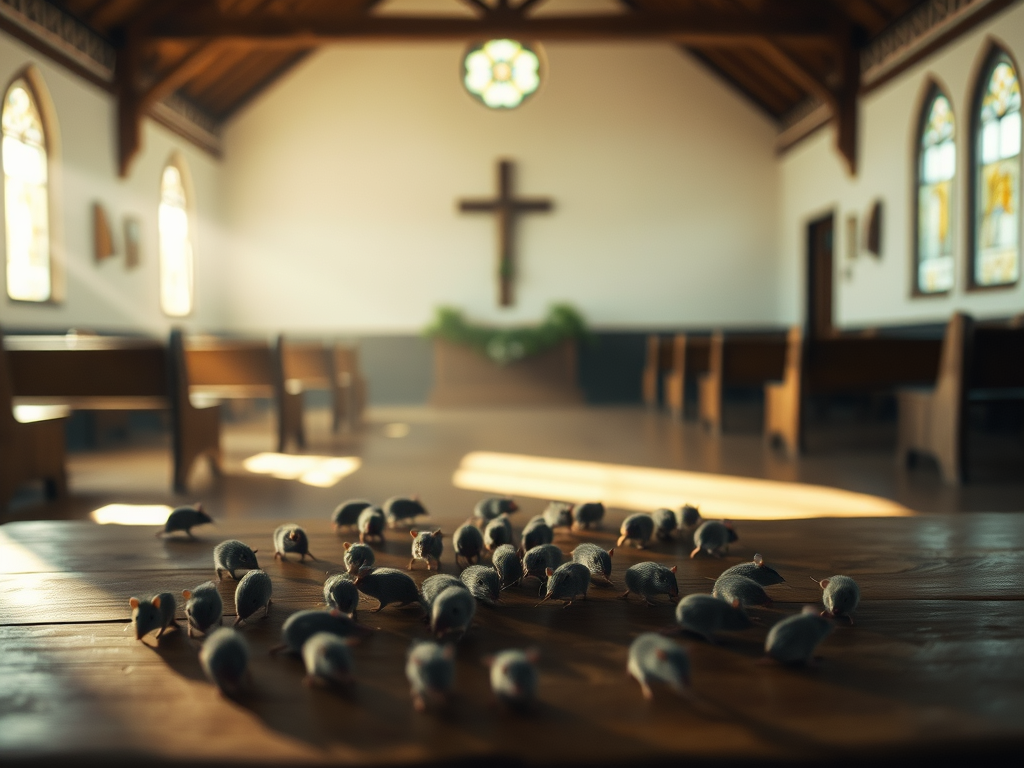
Stone Yard Devotional has a third visitation which is the most gruesome and the most detailed — a plague of mice.
The nuns try to maintain their normal rituals but every day is a battle with these creatures. They’re an inescapable presence “inside the walls, moving, moving, moving”, that burrows in and devours the very structures of the convent. They eat through electrical equipment and plastic, nest in the communal car and raid the food stores. The nuns set traps, emptying them every hour as the infestation grows, but they can’t dig holes deep enough to bury all the bodies.
I’ve grown to hate them. not just the plague but the creatures themselves. At night is loudest, when the other sounds of the world are stilled. No birds, no psalm practice, no miscellaneous noises of an occupied abbey. Only mice feet overhead, pattering across the ceiling and inside the walls, a sound like dried leaves falling.
By the end of the novel I was left with a multitude of unanswered questions.
Are these visitations meant to be allegorical? Is the battle with the mice symbolic of conflict in society perhaps — a kind of nature versus man. Or an infection that can take hold (the novel is set during the Covid pandemic)?
What are we meant to make of the skeletal remains that lie in a casket for many weeks while approval is sought for their burial? Is there meant to be a parallel between this physical act of burying the past and the narrator’s desire to bury her past emotionally through forgiveness?? Or is that stretching a point too far??
Why is there so little background given about the woman whose story we follow? All we learn is that she had a job in the environmental sector. She was heavily involved with multiple causes from threatened species to indigenous literacy, justice, food poverty and climate change and she’s severed connections with all of them. Why? We never get to find out nor do we discover what went wrong the marriage. That lack of context made it more difficult for me to understand why she needed to seek refuge at the convent.
This is a contemplative novel, almost like a journal of the woman’s thoughts and reflections. Many of the chapters in fact begin almost in note form. “Arrive finally at about three’,” is how one starts; in another she notes “Dreamed I had a beautiful pet.” We’re experiencing not a novel as such, more like a series of random thoughts that she wants to capture for herself rather than to share with anyone else. “Nobody will read this but me,” she says at one point while also admitting she is being selective with what she documents.
Stylistically this is a wonderful piece of writing — some of the descriptions about the mice just made me gasp and the flashback sections where she recalls her mother are very moving.. But I never felt fully engaged in the book or in her attempts to answer the big questions about faith, forgiveness and hope. I felt I was observing her dispassionately instead of walking with her hand in hand through those deliberations.






We’re all friends here. Come and join the conversation