
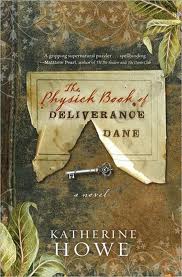
 I’m not going to beat about the bush on this. The Physick Book of Deliverance Dane is one of the worst books I have read all year. Not the absolute worst, but certainly only a whisker away from the bottom of the pile.
But before I explain why I’ve taken such a dislike to this book, here is a brief synopsis of its plot.
The novel is set in Massachusetts in the summer of 1991. It features the young, aspiring Harvard graduate student Connie Goodwin who intends to spend the summer researching for her doctoral dissertation. Her plans are thrown awry when her mother asks her to handle the sale of a long-abandoned house in Salem that once belonged to Connie’s grandmother. In the house Connie discovers a seventeenth-century Bible and hidden inside, a key and a small fragment of parchment bearing the words Deliverance Dane. Connie duly embarks on a quest to discover the identity of Deliverance Dane and the location of a rare book of physick. In doing so she discovers a personal connection to the Salem witchcraft trials of 1692.

Fact and fiction are woven together in this book through a dual time-frame narrative — in between the story of Connie’s quest, we experience scenes in the household of Deliverance Dane and in the jail where she awaited trial. Deliverance Dane did actually exist — she was one of many women condemned as a witch though, unlike nineteen other women, she escaped the hangman’s noose.
In the hands of a more experienced novelist, this could have been an interesting take on an infamous period in history. But this is Katherine Howe’s debut novel and sadly her inexperience is evident.
First of all the character of her protagonist isn’t that convincing. Here we have a girl who, right at the start of the book, wows a group of leading academics with her encyclopaedic knowledge and insightful interpretation of historical themes and issues. She has spent months amassing data from the past and yet we find only a few pages later that she is astonished to discover that up until the seventeenth century (one of the periods she has studied) the word receipt actually meant recipe. Maybe she should have watched some cookery programs on TV instead of reading academic tomes?
But there was an even earlier moment at which I rolled my eyes in disbelief. If you’d pitched up on the doorstep of a seventeenth century house (having first had to virtually hack your way through creepers and other vegetation to get the door) and discover it has no power or phone and is inches deep in dust; would you want to stay the night? No, neither would I. I hazard a guess that most girls in their early twenties also wouldn’t trade it for the comforts of their flat in Cambridge. But not our Connie. She not only stays the night, she makes it her for the summer.
If characterisation isn’t this book’s strong point, then neither is the writing style. The flashback scenes to the 1680s and 90s are, on the whole, evocative of the period but the modern day sections are riven with cliches, inconsequential detail about the character’s clothing and dry dialogue. And there are also some dreadfully clunky sections where the author tries to impart some factual information but can’t quite manage to do it seamlessly.
I’m conscious that all this sounds rather harsh criticism of someone’s first foray into the fictional world but actually I think the fault lies with the publisher and editor for failing to identify where improvements could have been made or maybe even suggesting that the book would have been so much better without the modern day hocus pocus quest.






We’re all friends here. Come and join the conversation