

Best sellers often fail to live up to the hype but in this case, the reputation of Ferrante’s novel is well deserved.
On the surface, it’s a novel about the friendship between two girls — Elena Greco and Raffaella “Lila” Cerullo — who grow up together in a Naples suburb in the 1950s.
But it gradually becomes much more than that. It’s about ambition, poverty, education, family and the difficult business of trying to become the person you might have been.
Elena is the narrator, looking back on her childhood and adolescence from later in life. She begins with the disappearance of Lila, who has apparently decided to erase herself completely. This sends Elena back through her memories, to the beginning of their friendship when they were eight years old.
Lila and Elena are fascinating precisely because neither fits exactly into a mould where one girl is “the clever one” and the other “the good one”.
Lila is fiercely intelligent, imaginative and completely unwilling to accept the limitations imposed on her by family members. Elena is more cautious and conventional but determined to educate herself and escape the restrictions of her background. They constantly compete with and inspire one another. At times they seem inseparable; at others, their friendship becomes almost a battle for superiority.
Ferrante is particularly good at capturing the uncomfortable mixture of admiration and jealousy between the two girls. Neither girl can quite possess what the other has.
Elena is a high achieving student but Lila so often outshines her, seemingly without even trying whereas Elena gets her results through hard graft. At the same time, Lila envies the support Elena gets to continue her education while she ends up working in the family shoe making business.
Would she always do the things I was supposed to do, before and better than me? She eluded me when I followed her and meanwhile stayed close on my heels in order to pass me by?
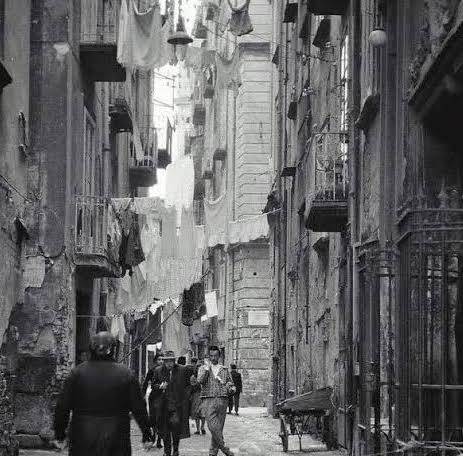
One of the most impressive things about My Brilliant Friend is Ferrante’s depiction of the neighbourhood (known as a rione) in which the girls grow up. It’s a poor, working-class community of apartment blocks, courtyards, small shops and narrow social boundaries. Ferrante makes it feel intensely enclosed, with its own rules and attitudes to life.
The neighbourhood isn’t simply a backdrop to the story. It almost becomes another character. Everyone knows everyone else’s business, families have long memories, old arguments are never entirely forgotten and violence is always lurking beneath the surface. There are rivalries between families, economic inequalities and an almost suffocating sense of social expectation. The Solara family, in particular, represents the power that money, intimidation and violence can have in such a tightly controlled community.
What makes Ferrante’s portrayal so effective is that she doesn’t romanticise this world. There is affection and familiarity in the neighbourhood, but there is also ugliness.
I feel no nostalgia for our childhood: it was full of violence. Every sort of thing happened, at home and outside, every day, but I don’t recall having ever thought that the life we had there was particularly bad. Life was like that, that’s all, we grew up with the duty to make it difficult for others before they made it difficult for us.
It is a place where people look after their own while simultaneously judging and undermining one another. There is a strong sense of community, but it isn’t necessarily a comforting one. The same closeness that provides security also makes it extremely difficult to escape.
And that idea of escape is crucial. Elena and Lila can see that another kind of life exists somewhere beyond the neighbourhood, but it often seems impossibly distant.
Education becomes one possible route out. Elena gradually realises that books and schooling might allow her to cross the boundary between her world and the wider world. Lila, despite being arguably the more naturally gifted of the two, is denied that opportunity. Their different fortunes demonstrate just how much circumstances, rather than ability alone, determine what someone can become.
I knew I was going to enjoy My Brilliant Friend from the very first page. I’m hoping the remaining titles in the Neapolitan trilogy are just as enthralling.



We’re all friends here. Come and join the conversation