

The American West is seen through fresh eyes in How Much of These Hills is Gold, a bold novel that challenges the rhetoric of America as “the land of the free.”
C Pam Zhang explores the Chinese immigrant experience in 19th-century America through the narrative of a couple (known simply as Ma and Ba) and their two children, Lucy and Sam.
Left as orphans after the death of their father, they strap his body to a horse and begin the search for a place where Ba can be buried according to Chinese traditions.
The project seems doomed from the start for they don’t have the two silver dollars to weigh down their father’s eyes. But they prove very resourceful, holding up a bank, stealing a horse and, in Sam’s case, wearing man’s clothing. Their quest takes them through hills left barren by prospectors and settlers. but also verdant pastures and hills where ‘grass bursts full green in the shade of a grove.‘
Because this land they live in is a land of missing things. A land stripped of its gold, its rivers, its buffalo, its Indians, its tigers, its jackals, its birds and its green and its living. To move through this land and believe Ba’s tales is to see each hill as a burial mound with its own crown of bones. Who could believe that and survive?
They encounter giant buffalo bones, tiger paw prints and evidence of the persecution of Native Americans, landscape as well as family secrets, sibling rivalry, and glimpses of a different kind of future.
The first three sections follow the two siblings as they cross the hills, remembering their parents’ stories of buffalos and tigers, with flashbacks filling in details of their parents’ lives as well as family secrets. In the final section we learn about Lucy’s later life when she returns to civilisation while Sam chooses a different path in life.
The novel reveals how their parents came to America, their struggles in the gold mining towns, and how the family was gradually torn apart by poverty, violence, and the harsh realities of immigrant life.
Ma was lured to the USA under false promises that she would find wealth in the Californian hills. Instead, she and hundreds of other Chinese migrants who travel with her, are pressed into building railroads. Her first thought is that she must return, somehow, to China but then she meets Ba and they forge a new life together.
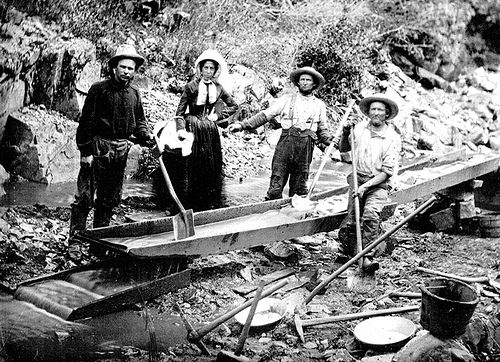
Though born in the US, Ba is still treated as an outsider, encountering subjugation and discrimination while working as a coal miner and a gold prospector. He takes his family on a restless quest to find a piece of land that will deliver up its bounty — every fibre of his body tells him that gold is there in those hills — but to no avail. Every site has been picked clean by prospectors who consider themselves “true” Americans and deny his right to claim America as his home. After enduring years of prejudice and hostility he tells his daughter that “This land is not your land,”
Zhang’s characters are not simply ciphers for a message about identity and the meaning of belonging. They are as vividly imagined as the mining towns and the rough terrain the family encounter as they move from one place to another, never settling anywhere for long.
How Much of These Hills is Gold has a strong poetic tone with motifs and phrases repeated at intervals throughout the book. This is a family that is trying to make sense of the world around them. Ba sets the tone early on with a question for Lucy “What makes a dog a dog?”. Later on, morphs into other questions “What makes a bed a bed,” and “What makes a boat a boat” , ending with the most thought-provoking of questions: “What makes a home a home?”
It’s a novel that took me a while to get into because of its unusual tone and structure but it gradually took hold of me. The final section, which takes place five years after Ba’s burial ,didn’t feel as strong as the earlier sections but overall, this was an impressive debut.



We’re all friends here. Come and join the conversation