

Emma Donaghue’s latest novel Haven is set in seventh century Ireland yet its message about the dangers of an arrogant, egotistical leader is something that wouldn’t be out of place today. I’m sure we can all think of a few modern-day individuals who are so sure of themselves that they reject all challenges to their ideas or plans.
Such a man is a seventh century holy man called Artt, esteemed for his learning (there’s a rumour that he’s read every book ever written) and knowledge of the world. So when he tells the monks at Cluain Mhic Nóise (in modern day County Offaly) that he’s had a powerful dream containing a message from God, they believe him. God has told him, he reveals, that he must leave behind the world of sin and seek out a more pure life on a solitary island “far away, in the western ocean”.
Not a man to hang about, Artt sets out forthwith to find the island and establish a new monastery. He takes two monks as companions — the day-dreaming ungainly youngster Trian, and the older more worldy-wise Cormac. .
His companions are delighted they have been singled out for such an honour. But they have no idea what lies in store for them nor the real nature of the man to whom they have sworn obedience.
Haven or Prison?
The trio end up drifting about on the Atlantic Ocean for days since Artt doesn’t really know where or how to find his haven from sin The island they eventually find doesn’t look much like the promised land — just a huge and largely barren mass jutting straight up from the water; covered in birds and guano but little else.
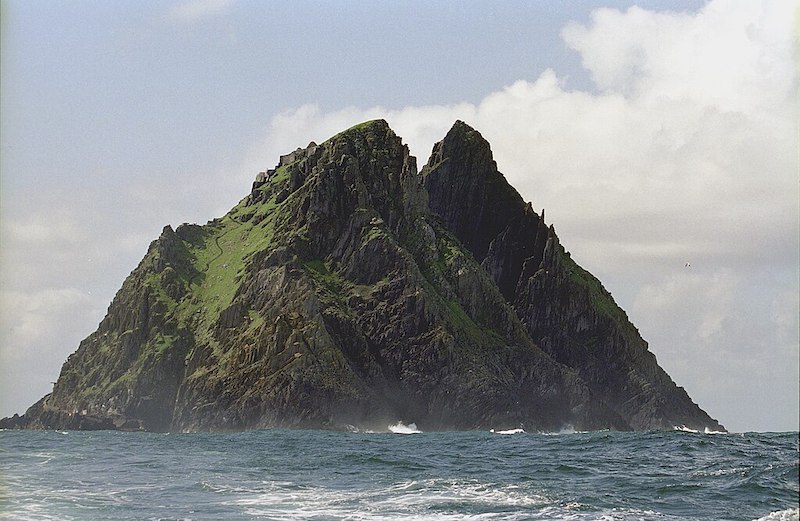
Cormac, the most practical of the threesome, has qualms about the realities of living in such a desolate place — a valid concern since many of the tools they need to build shelters or grow food were left behind. But Artt is undaunted. “This place … was set aside for us when the Earth was made,” he tells them. They will live out their days here “waging war on the devil with pen and ink.”
Artt is the boss so the two monks accept he knows best and just knuckle down to their new life as best they can. It’s a tough life, made even more arduous because Artt believes their personal comfort and well-being is secondary to glorifying God. He won’t even countenance building a shelter until Cormac has erected a cross and then a chapel and demands that Trian spends hours copying religious texts though the poor guy is an inept scribe.
Both Cormac and Trian discover inner resources to sustain them through Atlantic storms and dwindling food stocks. Cormac manages to grow a few herbs and vegetables and Trian becomes an adept fisherman but Artt’s obsession with fulfilling what he considers his destiny, stretches the monk’s vows of obedience to the limit.
To Obey or To Live?
The tension between duty and self-preservation builds slowly and steadily throughout Haven. We know this cannot possibly end well yet the crisis, when it comes, has a surprising dimension.
When I heard that the members of my book club had voted to read Haven this month, I admit that I reacted with a groan. The combination of religion, monks and a remote Island didn’t sound like a recipe I would enjoy.
But I was completely wrong. Haven turned out to be a superbly atmospheric tale. it was unsettling at times because of Artt’s lack of respect and concern for his two companions and the way he forces them to act against their inclinations. As readers we see the true nature of this cruel man but it takes a while before Cormac and Trian do so.
Haven is a remarkable novel, reminiscent in some ways of her earlier best-selling novel Room in the sense that it deals with captivity and the struggle to survive in a small space cut off from the rest of the world. it’s much more however than just a re-working of the earlier novel.
Haven by Emma Donaghue — Footnotes
The island that features in this novel is based upon Skellig Michael, one of two skelligs (crags) that lie in the Atlantic Ocean about seven miles off the coast of County Kerry. Emma Donaghue took a boat trip around the skelligs in 2016 and planned to return and land, but was thwarted by Covid restrictions.
Had she made it onto the skellig, she would have found the remains of a monastic settlement established between the 6th and 8th centuries. The remains are in such good condition the island was declared a World Heritage Site in 1996.




We’re all friends here. Come and join the conversation