

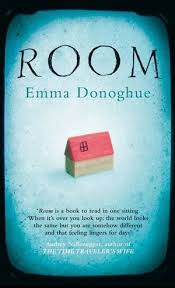
What interested Emma Donoghue most was not the experience of the abuse or the confinement in a soundproofed garden shed but how the victim and the son Jack that is born as a result of rape, deal with the challenges of life outside.
This is the story told by Jack. He’s five years old, born in captivity, whose knowledge of the world is limited to the 12-foot-square room he occupies with his “Ma”. Their only contact with the world outside comes via their captor “Old Nick”, who delivers their food, a weekly “Sundaytreat” (new trousers, painkillers, the occasional candy bar) before raping Ma. She uses every ounce of her energy on nurturing and teaching her child, creating rituals that help preserve her sanity. Theirs is a very private world, with its own language and cast of characters that Ma creates out of the sparse items in their room. “Melted Spoon”, “Rug”, “Wardrobe” and “Plant” become friends as real for Jack as the cartoon characters he loves to watch on TV. Ma limits his tv time though so his “brain doesn’t turn to mush” and makes him do “phys-ed” every morning which consists of running around the room and bouncing on the bed. In between they make up poems, sing Kylie songs and create a snake from old egg shells.
For Jack every day is a day of wide-eyed discovery and joy. Ma however can recall life “outside”. Not surprisingly some days she just succumbs to despair, days when in Jack’s eyes she is “gone” and he is left to his own devices. Ma however is an exceptional woman, one whose love for her son gives her the courage to make a bid for freedom.
When the second half of the novel moves to “outside” it loses some of its intensity but gains a new dimension in which the close mother-son relationship is put the test as Jack has to share his mother with other people. He has to learn that what was acceptable ‘inside” the room is not acceptable “outside” and to acquire skills he never needed before like tackling stairs and wearing shoes. Jack’s introduction to this confusing new world and to gradual removal of his previous dependency on his mother is handled with remarkable skill and insight.
While it was almost impossible not to shudder at the plight of this pair it was equally impossible not to be totally enthralled by Jack. It’s not easy inventing a credible child narrator but in Jack, Donaghue delivers one whose voice is so memorable I could hear him long after I closed the book each day. He is the figure whose sweet innocence mitigates the horror, the figure that ensures the book never descends into the simplistic mode of villain versus victim pure monster It’s one of the reasons this is a novel like no other I’ve read in recent years.
End Notes
Emma Donoghue was born in Ireland but now lives in Canada. Room was longlisted for the Man Booker Prize in 2010. It was released as a film in 2015.
Emma Donaghue talks about the writing of her novel in an interview with the Guardian