

Nancy Mitford’s Love in a Cold Climate is supposed to be the novel that best displays her reputed “genius” for sharp and provocative wit.

Naturally, I was expecting to encounter writing that fizzed, crackled and sparkled as Mitford pricked the bubble of complacency surrounding rich, aristocratic families.
What I got instead was a slightly funny book parading the absurdities of a bunch of people who are supremely confident in many things, but particularly their superiority above all other mortals.
I felt cheated. Much like you do when you pull the Christmas cracker but end up with nothing more than a feeble pop and an empty roll of coloured cardboard. Not even a tiny packet of playing cards or a giant paper clip to make the effort worthwhile.
An Unsuitable Match
Love In a Cold Climate brings us the tale of Polly Hampton, more properly known as Lady Leopoldina. She’s the only child of an immensely rich and very aristocratic Earl of Montdore and his wife, Sonia.
Polly shines amid the debutants who have flocked to London for the ‘season’; the annual series of glittering balls and big social occasions whose real purpose is to find a marriage partner. Much to her mother’s frustration, however, Polly shows little interest in the London season and the men she meets consider her cold and aloof.
The cause of Polly’s indifference is revealed to her shocked family: she’s been in love with her uncle, “Boy” Dougdale since she was fourteen. She’s hell bent on marriage to a man considered by all and sundry to be eminently unsuitable as a husband; he’s a serial womaniser and known for his lecherous behaviour towards young girls.
Polly is determined to have her own way. Her punishment is banishment and disinheritance.
Mitford’s characters
You won’t find a lot of humour in the plot. The wit resides instead in Mitford’s characterisation, in particular the figures of Lady Montdore and Uncle Matthew.
Matthew is great fun as a character. because he’s so over the top. He plays the role of a conventional English Lord very well, with his love of hunting, fishing, shooting and his firm belief in the importance of lineage. He has little tolerance for silly, ignorant women and even less for the business of bringing girls out into society (expensive nonsense in his eyes).
The most fascinating character is however Lady Montdore.
A portrait of egotism
She’s a woman who is so easy to dislike with her “worldly greed and snobbishness, her terrible relentless rudeness.” The forcefulness of her personality generally ensures that she gets her own way, whatever the situation though she can also exploit the social status conferred by her husband’s title and wealth.
So wrapped up in her desires to be the hostess with the mostest and to secure a brilliant marriage for her daughter, Lady Montdore has no idea how condescending she can appear. Marriages of acquaintances and relatives are dismissed as inferior and inappropriate unless they involve solid assets like “acres, coal mines, real estate, jewels, silver, pictures..” All of the things in fact that her husband has in vast quantitites.
She’s not afraid to use her influence to prevent such a social calamity. Upon discovering that her daughter’s friend Fanny has made a “quite ridiculous” engagement to a professor, she offers to call the editor of the Times on the girl’s behalf, to retract the announcement.
Masterclass in how to patronise
One of the funniest scenes in the novel is when Her Ladyship makes an unplanned afternoon visit to the – now married – Fanny. It’s a master class in how to be patronising.
I suppose your husband is a clever man , at least so Montdore tells me. Of course it’s a thousand pities he is so dreadfully poor – I hate to see you living in this horrid little hovel, so unsuitable.
And with that she wrinkles her nose at the weak tea and broken digestive biscuits served without the nicety of a plate or napkin.
But worse is to follow when Lady Montdore puts on her “we’re hard done by” act:
It’s all very well for funny little people like you to read the books the whole time, you only have yourselves to consider, whereas Montdore and I are public servants in a way, we have something to live up to, tradition and so on, duties to perform, you know, it’s a very different matter. A great deal is expected of us, I think and I hope it’s not in vain. It’s a hard life, make no mistake about that, hard and tiring but occasionally we have our reward – when people get a chance to show how they worship us, for instance when we came back from India and the dear villages pulled our motor car up the drive, Really touching!
If only all of the novel could have been as delicious as this episode.
The saga of this odd romance and its consequences are related by Fanny Wincham, a distant cousin of Polly and a frequent visitor to the family’s home.
And therein lay my biggest issue with this novel: Fanny is a very dull girl. Fanny is the sensible one, the friend who longs for a stable life (understandable perhaps when you’re mother is known as ‘The Bolter’ because she left so many men in the dust)
I suppose Fanny had to be rather ordinary, in order to make a sharp contrast with the larger than life characters of her Uncle Matthew and Polly’s mother, Lady Montdore. But I would have appreciated a narrator with a little more to her than this ‘nice’ but tepid individual. Perhaps then her observations would have helped the book live up to its much vaunted status as the work of a genius.
Love In A Cold Climate: Endnotes
Nancy Mitford was one of six daughters of a British aristocratic family (the very class she features in her novels). The siblings achieved fame/notoriety in 1930s, three of them because of their political affiliations. A journalist for The Times, Ben Macintyre, labelled them “Diana the Fascist, Jessica the Communist, Unity the Hitler-lover; Nancy the Novelist; Deborah the Duchess and Pamela the unobtrusive poultry connoisseur”.
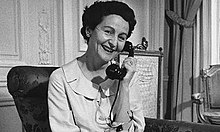
Nancy Mitford, encouraged by her friend Evelyn Waugh, began writing to augment the meagre allowance she was given by her father. Her first efforts were anonymous contributions to gossip columns in society magazines, but in 1930 she was engaged by the magazine The Lady to write a regular column.
Her first forays as a novel writer were not tremendously successful; the luke cool reaction to her early attempts cooled her interest. But after a gap of several years she began writing again. The result was the heavily autobiographical The Pursuit of Love. It became an instant success, her reputation as a novelist cemented with the follow up: Love in A Cold Climate.
I added Love in a Cold Climate to my Classics Club list having seen it described as a “masterpiece’ of witticism. I also included her earlier novel The Pursuit of Love but now I’m wondering if that will be just as disappointing.
- Read more about the Mitford family in this BBC article.
- Vanity Fair has a published an interesting feature exploring why the six Mitford sisters continue to fascinate people.
- Ali who blogs at HeavenAli is more of a fan of the Mitford writers, than I seem to be. Check out her reviews here.