

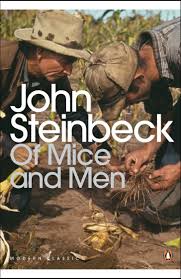
Having tried but failed to get enthused by The Grapes of Wrath, I had formed the impression that all of Steinbeck’s work would be similarly dark and depressing. I was completely unprepared for a book which reverberated with warmth and understanding and that packed so many ideas into just over 100 pages.
Of Mice and Men is essentially a parable about dreams and the obstacles that stand in the way of achieving them; a story about people who are life’s losers yet never relinquish their hopes and ambitions for a better life.
The two central characters are George Milton and Lennie Small, migrant workers who drift around California in search of work. When the book opens they are on their way to a ranch where they are due to start jobs as agricultural labourers. These are not people who have grand ambitions; all they really want in life is a place they can call their own. They begin their journey full of optimism that their endeavours will help them realise their dream of owning their own farm and being in control of their own destiny.
Someday we’re gonna get the jack together and we’re gonna have a little house and a couple of acres an’ a cow and some pigs….
…we’ll have a big vegetable patch and a rabbit hutch and chickens. And when it rains in the winter, we’ll just say the hell with goin’ to work and we’ll build up a fire in the stove and sit around it an’ listen to the rain coming down on the roof.
Steinbeck portrays George and Lennie as innocents caught like mice in a maze of modem life. Lennie in particular is depicted as a simple soul, a man who loves soft creatures and who never tires of hearing his friend tell the story of their future life together when they will – in Lennie’s words “live off the fatta the lan”. Though Lennie can’t retain practical information for very long (he doesn’t even remember where he and George are going tomorrow), the story of their future life is one he’s heard so many times he can practically repeat it word for word.
Lennie in essence is a simple-minded man of great size and strength. But he has a flaw in his character that will ultimately cause a tragic accident and the collapse of their dream. Though all does not end well for this pair, what Steinbeck succeeds in showing is that dreams are what sustain us. Without them, life is an endless cycle of days without meaning. Without someone to share those dreams, they become empty of life and vitality.
Ultimately, the ties of affection and love between the two men are what bind them together. They may have nothing of material value but they do have each other helping to keep alive the flame of their desire and hope.
George said: ‘Guys like us got no family. They make a little stake an’ then they blow it in. They ain’t got nobody in the worl’ that gives a hoot in hell about ’em—’
‘But not us,’ Lennie ended happily. ‘Tell about us now.’
George was quiet for a moment. ‘But not us,’ he said.
‘Because —
‘Because I got you an’ —
‘An’ I got you. We got each other, thats what that gives a hoot in hell about us.’
The Verdict
A delightful novel even if at times it has a sense of inevitability that is unwelcome.